
Recognition and communication create experience. Reflection determines what we carry forward.
CIS™ System ComponentReflection that refines recognition and recalibrates judgment.
Clinical judgment develops when experience is examined rather than simply accumulated. CRISP™ creates a structured opportunity to revisit what was noticed, how it was interpreted, what happened next, and what should be reinforced, revised, or reconsidered.
Over time, reflection can help clinicians carry better-calibrated recognition into the next clinical encounter.
Reflection is not only about confirming what worked. It creates space to examine where recognition, interpretation, communication, or judgment may have been incomplete or wrong.
Some of the most important clinical processing happens after the moment has passed — when clinicians reconstruct what they noticed, question what they interpreted, and consider what they will carry into the next encounter.
CRISP™ gives that invisible reflection structure.
Reconstruct the clinical moment. What changed? What stood out? What happened next?
Examine the cues, context, assumptions, and reasoning that shaped your response.
Compare your interpretation with the available evidence and outcome. What supported it? What challenged it?
Reinforce what was sound. Revise what wasn’t. Identify what you need to understand better.
Carry examined learning into the next signal.
The goal of reflection is not to prove that the original instinct was right. It is to understand what informed it, what the evidence later revealed, and what should be carried forward — or changed — the next time a similar pattern appears.
CRISP™ gives that examination a structure.
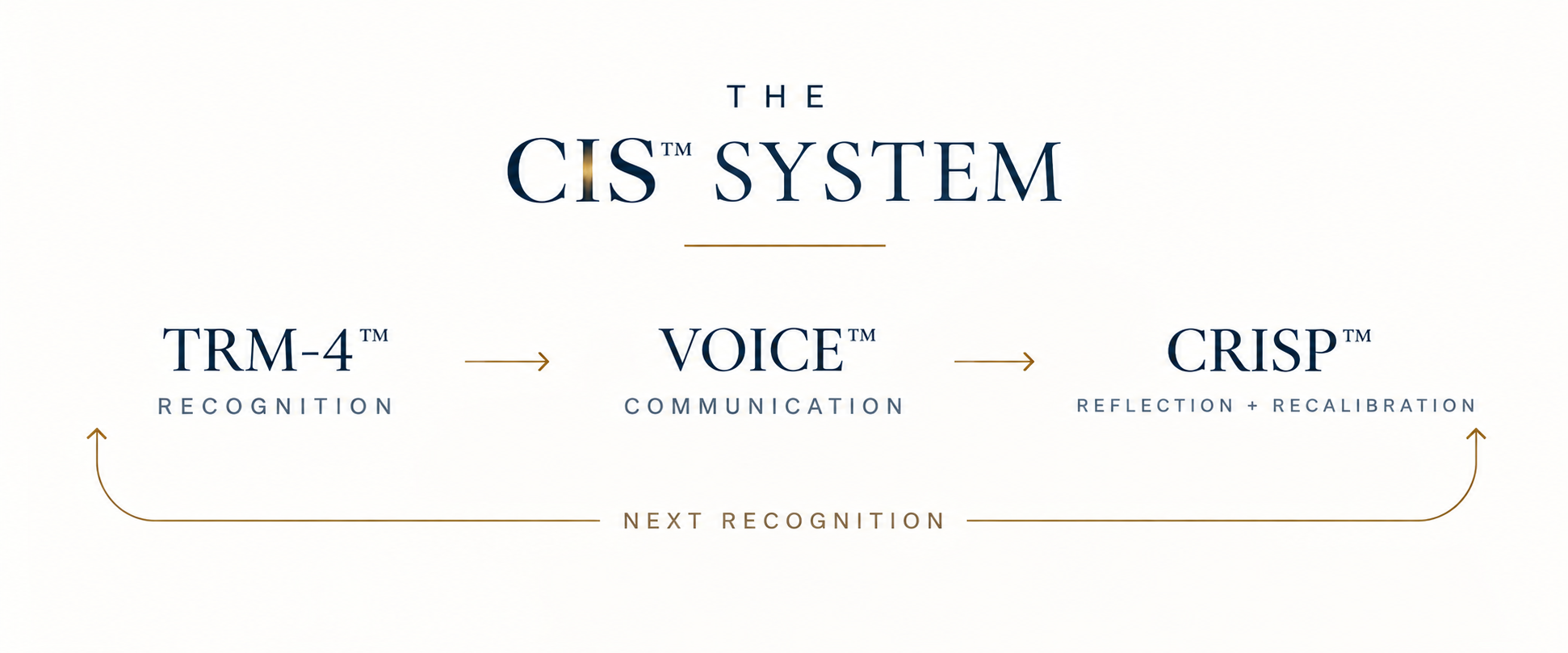
Reflection is where experience is examined, judgment is recalibrated, and the next recognition begins.
You’ve seen the whole loop. Now feel it.
Ninety seconds inside a clinical moment. See what you notice before the system tells you what matters.
Experience CIS™ in the moment →